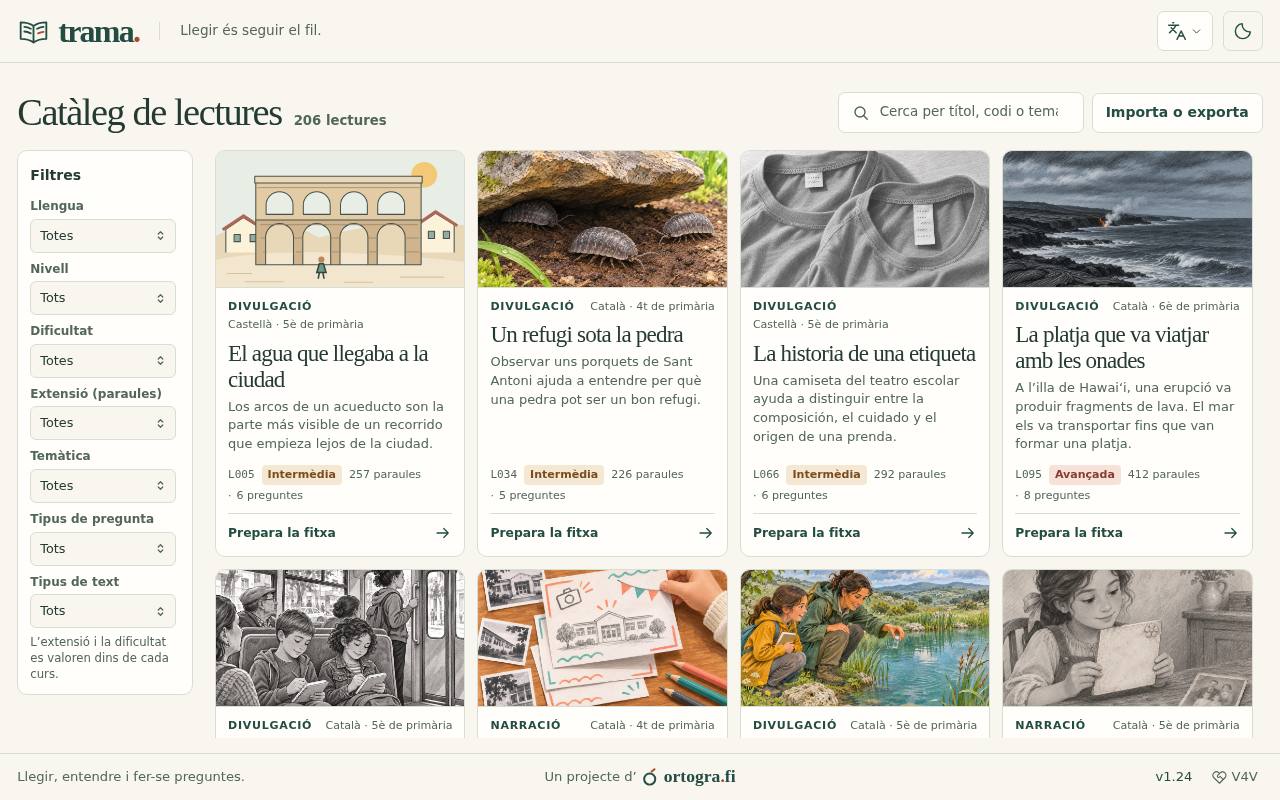
Trama offers 206 reading texts with questions for building reading comprehension worksheets
The catalogue, in Catalan and Spanish, is aimed mainly at the fourth to sixth years of primary school and lets teachers choose the questions before printing the worksheet or downloading it as a PDF.
Trama is an online catalogue of reading comprehension texts, created by Aarón Fortuño. It opens in the browser, under the motto “Llegir és seguir el fil” (“To read is to follow the thread”), and on 16 November 2026 it showed 206 texts. Each one lists its text type (popular science, narrative, instructions or letter), language, school year, difficulty, word count and number of questions. Among those visible on the home page are, for example, a text about an aqueduct, another about the porquets de Sant Antoni (woodlice) sheltering under a stone, and a letter from a girl to her aunt about a family radio.
Teachers can search by title, code or topic and filter by language, level, difficulty, length, theme, question type and text type. The page itself makes clear that length and difficulty are judged within each school year. Clicking “Prepara la fitxa” on a text lets teachers choose the questions and adapt the worksheet (format, answer space and header) before printing it or downloading it as a PDF. According to the description of the entry in the repository, the worksheet also comes with an answer key, which is useful for marking without having to prepare the answers separately.
The texts are in Catalan and Spanish, and the interface can be switched between the two languages. According to the information on the website, 96 texts exist in both languages, so the same activity can be used in a bilingual classroom or in the other-language version of a school. The texts are for primary school, with years four to six in what the home page shows.
Another feature is importing and exporting your own texts in JSON format, a text file with a fixed structure (title, language and paragraphs and, if wished, questions and answers). That way, a teacher can add their own texts to the catalogue in their browser; according to the website, imported texts are saved in the browser itself.
Trama is free, does not require an account to browse the catalogue and is a project of ortogra.fi, which also produced Fil i compte, which prepares maths problem worksheets. The code is published under the MIT licence and the texts, questions and answers under a CC BY 4.0 licence, which allows them to be reused with credit to the author. The website does not specify what student data it processes, if any: as far as can be seen, the tool is used by the teacher and students work with the printed worksheet.