Forxa lets you design parts in real millimetres and make them with a 3D printer or laser cutter
Luis Vilela Acuña has created a web app for classroom design from the third year of primary school (ages 8 to 9), exporting the result as STL or SVG; according to its author, it works without accounts or a server.
Forxa is a web app, created by Luis Vilela Acuña, for designing parts in real millimetres and then making them with a 3D printer or a laser cutter. The idea is to draw once and choose at the end which machine will make it.
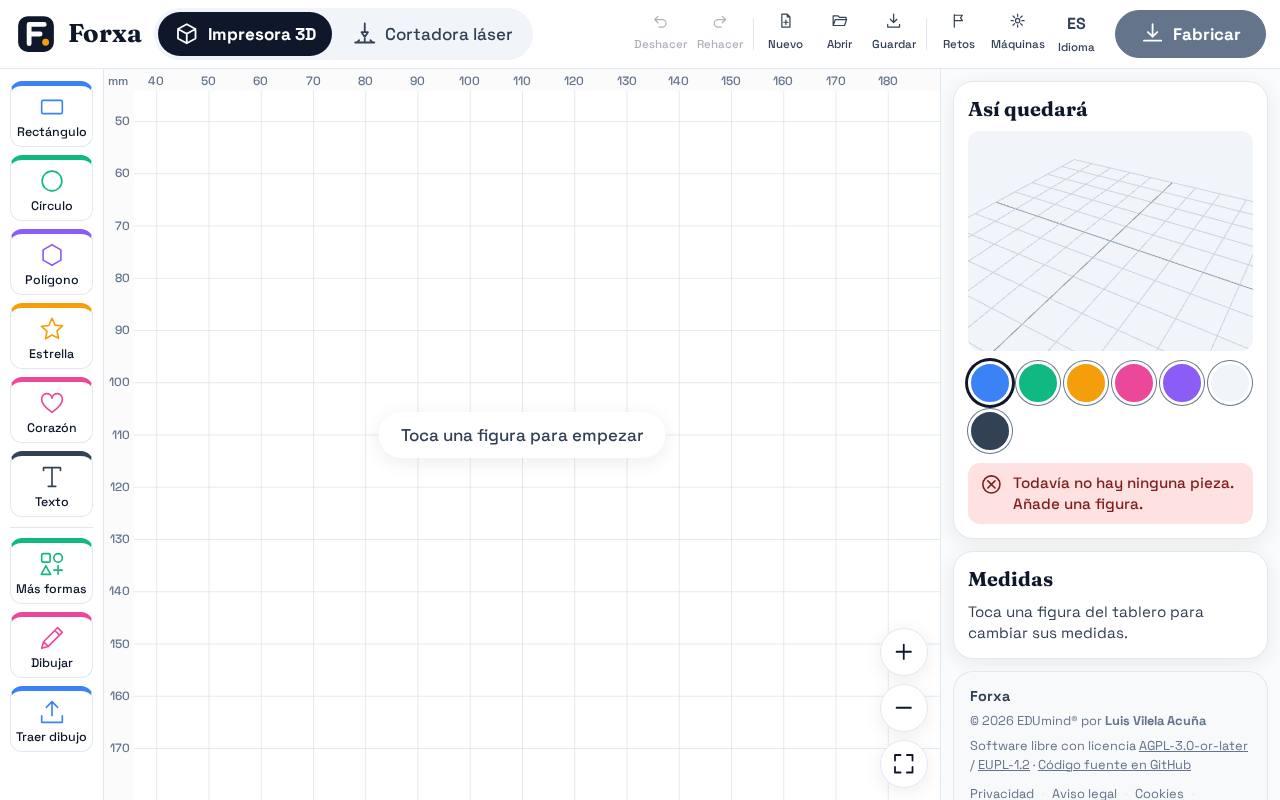
In the editor you can draw basic shapes, add text, take shapes from a library, make freehand strokes and import silhouettes in SVG. For parts that stand upright, according to its author, it includes tab-and-slot or cross-halving joints, and the slots are calculated from the thickness of the project's material. That is a useful detail when working with card, wood or acrylic, because the parts really do have to fit together.
For making, the app exports an STL file for the 3D printer or an SVG in millimetres for the laser, where red marks the cut and black the engraving. Before exporting, according to its documentation, it runs an automatic check of the size against the machine, of parts that are too thin and of loose pieces. The default machine sizes (220 × 220 × 250 mm for a printer and 500 × 390 mm for a laser) can be changed in the “Machines” section.
For the classroom, its author pitches it from the third year of primary school (ages 8 to 9), with guided challenges that check themselves, so students can move forward without the teacher reviewing every step. The repository entry lists primary, secondary, Bachillerato (the final two years of secondary school, ages 16 to 18) and vocational training, with the areas of science and technology, logical-mathematical thinking, and arts and humanities. It could be used, for example, in a technology workshop or in a digital fabrication project that combines design and maths.
According to its author, it runs in the browser with no application server, no accounts, no analytics and no requests to third parties: the calculation happens on the device itself, and the fonts and libraries are included. The interface is in Spanish and Galician. It opens at forxa.edumind.es. The features described are those stated in its entry and its documentation on GitHub, where the code is licensed under AGPL v3 or EUPL 1.2, at the choice of the person using it.