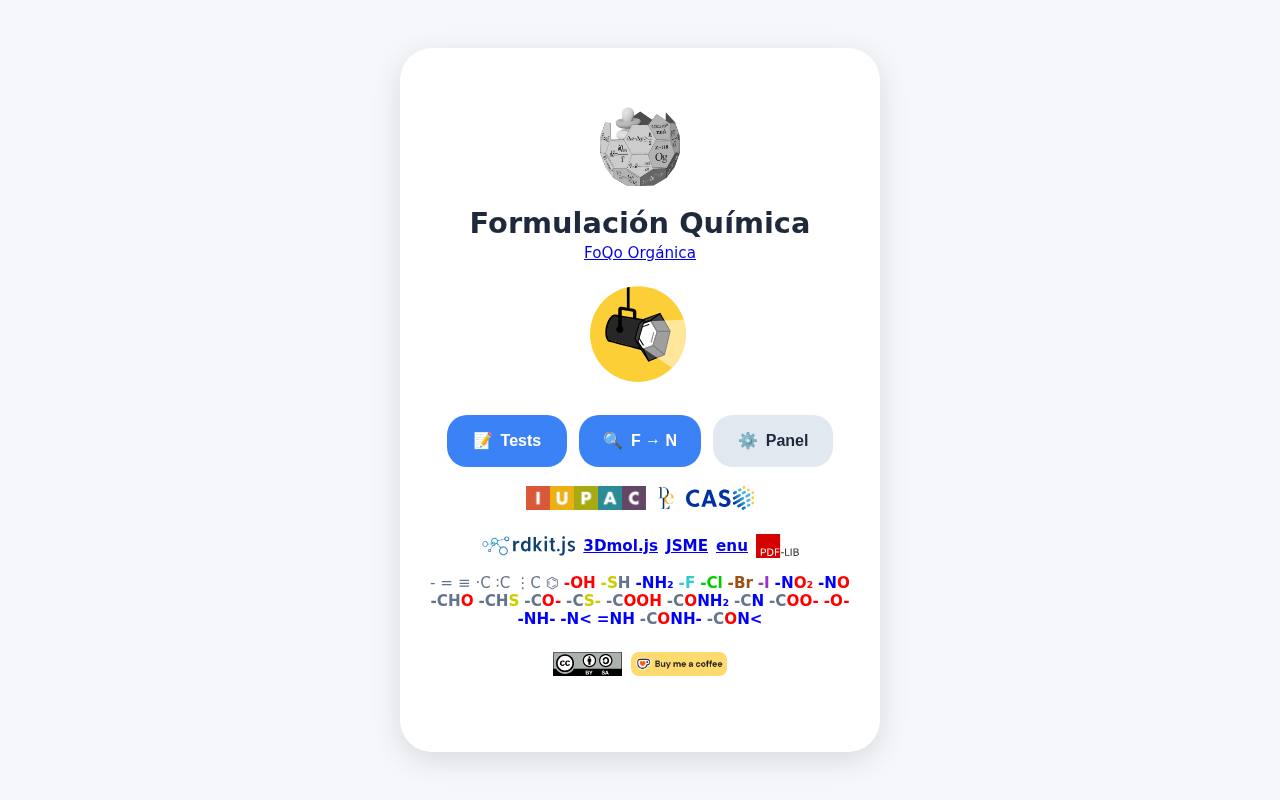
FoQo generates organic formulation tests and gives the name of a drawn structure
FiQuiPedia’s app lets users practise organic chemistry nomenclature with configurable tests and a tool that goes from formula to name.
FoQo, “Formulación Química Orgánica”, is a FiQuiPedia web app for practising the nomenclature of organic compounds. The repository listing places it in Secondary, Upper Secondary and University, within Science and Technology, and it is in Spanish. It is a page with no apparent registration: on opening, it shows three entry points directly, with no login form.
The start screen offers three buttons: “Tests”, “F → N” and “Panel”. According to the listing’s description, the tests ask users to name a compound from its formula or to write the formula for a given name, and the panel lets them configure the type of exercise: chains, double and triple bonds, radicals, branching, functional groups and rings. The “F → N” tool serves, again according to the listing, to obtain the name and properties of a formula or of a structure drawn in the editor. The page shows the palette of bonds and functional groups (-OH, -COOH, -NH₂, -NO₂ and others) used to build the molecules, and cites the JSME and 3Dmol.js libraries, which power the editor and the molecule viewer.
The listing says it supports several representations (condensed, skeletal, rectangular-scheme and 3D) and that users can consult both the 2013 IUPAC nomenclature, with the preferred name (PIN), and the 1993 one. For teachers, the listing notes that it can be used in class, for homework or as independent practice, with PDF export and as a SCORM package for Moodle. These features come from the listing’s description; the screenshot only shows the start screen.
The work carries a dual licence: AGPL v3 for the code and CC BY-SA 4.0 for the content. The page links to the code on GitLab and to the libraries it uses.