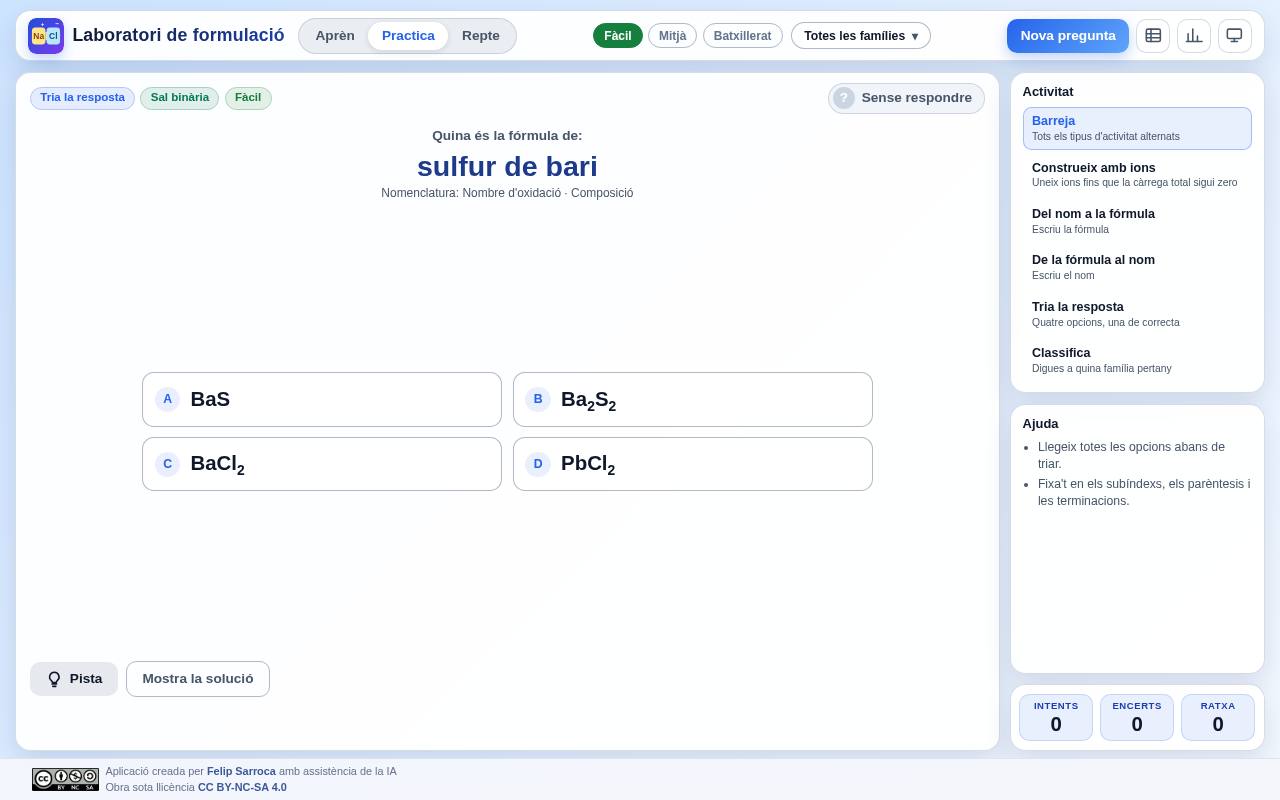
A Catalan-language lab lets students practise inorganic formulation with questions, hints and challenges
“Laboratori de formulació”, created by Felip Sarroca i Gil, offers inorganic nomenclature exercises for Secondary and Upper Secondary students, with three working modes and a progress counter.
“Laboratori de formulació” is a web app for learning and practising the formulation and nomenclature of inorganic compounds. According to the repository listing, it follows the 2005 IUPAC recommendations and is aimed at students in Compulsory Secondary Education and Upper Secondary, in the area of Science and Technology. It is entirely in Catalan, and the footer states that Felip Sarroca created it with the assistance of artificial intelligence.
On opening, the header shows three modes: “Aprèn”, “Practica” and “Repte”. In practice mode, which is the one shown in the screenshot, a multiple-choice question appears with four answers, for example the formula for barium sulphide, with the compound family label (“sal binària”) and the level (“fàcil”). Below are buttons to ask for a hint or show the solution. Users can filter by level (easy, medium and Upper Secondary) and by compound family, and the side panel lets them choose the type of activity: a mix of all, building compounds by joining ions until the total charge is zero, going from name to formula, from formula to name, choosing among four options or classifying a compound into its family.
A counter of attempts, correct answers and streak accompanies each session. The page states that progress is saved only in the browser and offers a table of ions. According to the listing, it also includes a projector mode designed for the interactive whiteboard, which cannot be seen in the screenshot.
For teachers, the resource can serve as independent practice for students or as a revision activity projected in class. It opens in the browser and shows no login or payment screen. Anyone teaching in Spanish should bear in mind that all the text, both the questions and the help, is in Catalan.
The work is shared under a CC BY-NC-SA 4.0 licence, which allows it to be adapted with attribution, for non-commercial use and with derivative works shared under the same licence.